

Bottom Line Up Front
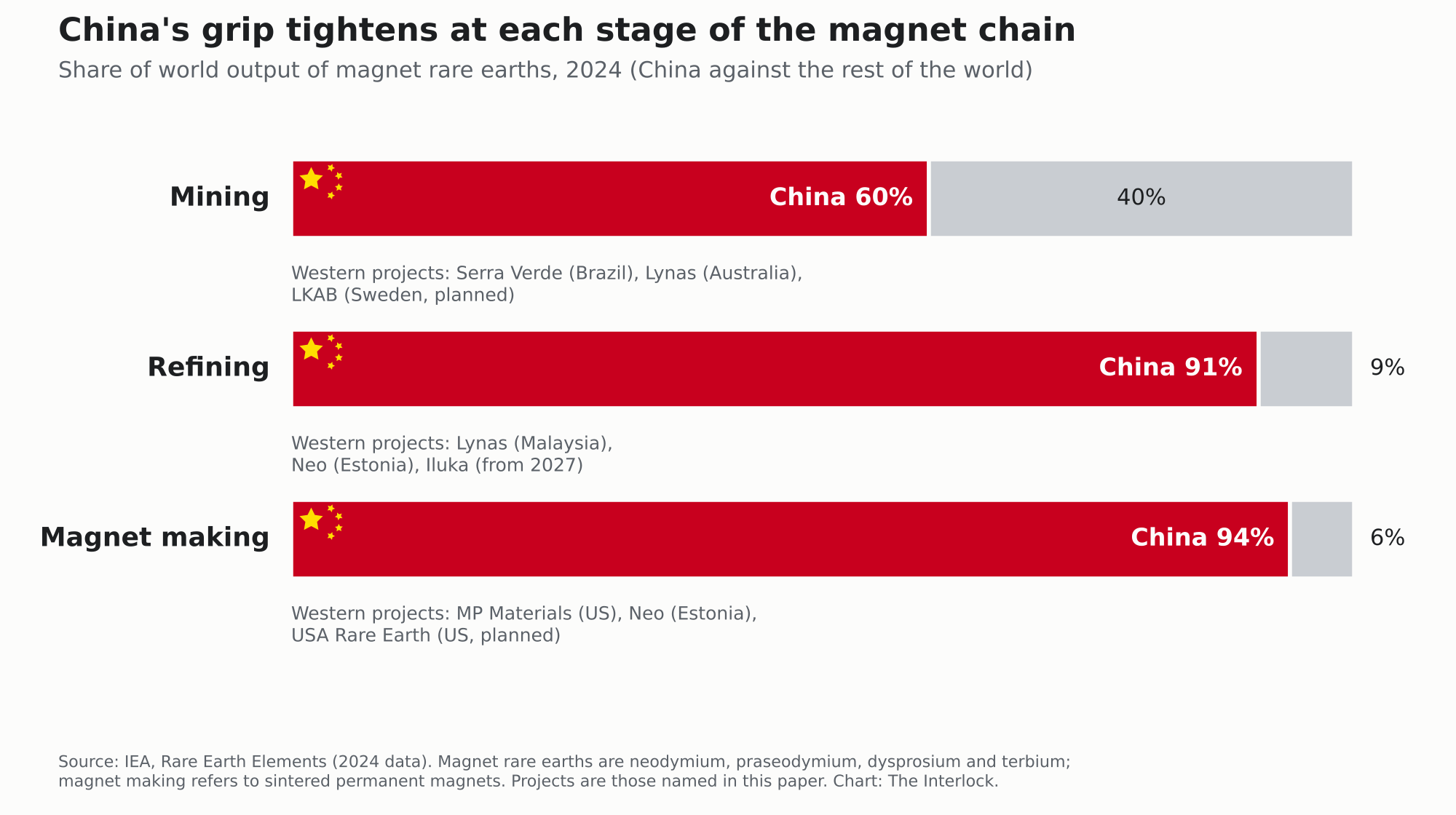
Whilst the world has been busy with the US midterms and allegations of Jensen Huang’s affair with a Chinese spy, there have been some important announcements on rare earth materials. If you have not studied this recently, you should, because China still holds a significant grip on rare earths used in the magnets for electric cars, wind turbines, phones and missiles, and continues to make almost all the world’s magnets.
Earlier today, China’s Ministry of Commerce extended its pause on wider export controls on rare earths and other critical minerals until 10th January, 2027. But this still leaves China with significant power over Western industry, defence and energy. Europe has done little to offset it or to prepare for the higher prices and lower profits that may follow.
What the tariff truce leaves unresolved...
Whilst the extension of the tariff truce announced 9th November, 2026, delays immediate problems until after Christmas, there are still significant problems left unresolved.
The April 2025 licensing, which covers dysprosium, terbium and five other metals, remains in force, so these exports continue but need a licence.
Those licences keep dysprosium outside China at more than ten times its Chinese price, so much of the value of mines and refiners elsewhere rests on a dispute the extension does not touch.
MOFCOM’s short statement did not say whether the separate pause on US-specific gallium, germanium and antimony curbs, due to end on 27 November, is also covered.
Why these metals matter: Dysprosium and terbium keep magnets working at the high temperatures found in electric vehicle motors, wind turbines and missiles, whilst the other five (samarium, gadolinium, lutetium, scandium and yttrium) are used in defence magnets, medical imaging, aerospace alloys and protective coatings. China currently supplies almost all of them.
What does this mean for boards and analysts?
In September, dysprosium cost about 16 times more outside China than inside, on Benchmark’s figures, and how long that gap lasts depends on decisions in Beijing and Washington. If China’s wider export controls return when its pause ends on January 10th, prices outside China are likely to rise further, and defence and industrial manufacturers may find it harder to secure supply.
This is significant for British car, wind and defence plants, which have little protection if magnet supply breaks. Less Common Metals in Cheshire, one of the few alloy makers outside China, is small and is likely to send its output to US plants first under its owner, USA Rare Earth.
To prepare, companies will need to identify which components would be caught if China’s export controls return, and how quickly each could be replaced or licensed, since China’s rule covers magnets made anywhere with as little as 0.1% Chinese rare earths by value. Defence suppliers have less time, as the Pentagon’s restriction on magnets containing Chinese material starts on 1 January.
Financial projections and balance sheets will also need to consider that European rare earths and magnets are likely to cost more than Chinese ones for years, so buyers who switch will pay for security through higher input costs, and European projects depend on customers or governments covering that premium.
The price differential between China and the rest of the world is likely to widen if fighting in Myanmar’s Kachin State cuts the heavy rare earth ore reaching Chinese refiners and Beijing keeps more for its own manufacturers, if China’s pause lapses in January or if Beijing tightens licensing. For context, there has been heavy fighting in Kachin State in recent years, it has already disrupted supply once, and it was still going on in mid-2026.
What can the West do to manage the China risk?
New heavy rare earth supply outside China
The main way to narrow the price gap and dependence on China is clearly greater alternative heavy rare earth supply.
Lynas began separating dysprosium and terbium in Malaysia in 2025, the first commercial output outside China, and Iluka expects to commission its Eneabba refinery in Western Australia in 2027.
Serra Verde in Brazil, now owned by USA Rare Earth and backed by US$565m of DFC finance and a US$750m Pentagon offtake, expects to produce about 6,400 tonnes of rare earth oxides a year by the end of 2027, roughly a third of them heavy rare earths.
LKAB plans to recover rare earths as a by-product of profitable iron ore mining, which suggests diversified miners with existing operations are also well placed to assist.
However, even with these projects, Benchmark Mineral Intelligence expects the West to rely on China for about 91% of its heavy rare earths in 2030, down from 99% in 2024, and CRU expects mines outside China to meet only 29% of the heavy rare earths used by car and wind manufacturers outside China by 2035.
Investing in making magnets outside China
Good examples are Neo Performance Materials, which opened a 2,000 tonne a year magnet plant in Estonia in September 2025, and USA Rare Earth, which now owns both Serra Verde and Less Common Metals, and is building a chain from mine to magnet for the US market.
Using less dysprosium and terbium
Honda has used magnets free of heavy rare earths in hybrid motors since 2016, and wider take-up would cut dependence faster than new mines, although it would also erode the dysprosium premium.
Recycling
HyProMag’s plant in Birmingham, opened in 2026, supports the UK’s target for critical minerals of 20% of demand through recycling by 2035, although volumes are likely to stay small until more magnets reach the end of their life.
Europe’s approach to date...
As with much of EU policy, Europe has been slow and piecemeal in waking up to this national security and economic risk.
European officials and investors argue that Europe must copy the method China used to build its processing capacity, with state support running from the mine through to refining. But it is not at all clear how this would be funded given the already extensive pressures on governments budgets. The Nordics, as is so often the case, are leading the way. LKAB is state-owned, Denmark’s Export and Investment Fund is among the largest shareholders in Amaroq, and the Norwegian government took over planning for the Fen deposit to speed up development for the privately owned Rare Earths Norway.
But the money is short of the ambition, as completing the projects designated under the Critical Raw Materials Act is estimated to cost more than €43bn against an EU fund of €3bn. Bloomberg reports that European spending so far is much less than China’s or Washington’s, which raises the risk that allied supply, such as Serra Verde and Less Common Metals, now both owned by USA Rare Earth, flows to the United States first.
Little new European supply arrives soon, since LKAB’s full-scale plant at Luleå in Sweden may not operate until the early 2030s, its Per Geijer deposit near Kiruna is undeveloped and Norway’s Fen deposit is still at an early stage, so European manufacturers are likely to stay dependent on China through this decade.
Whilst the EU is backing projects through offtake agreements, Bloomberg reports no EU price floors comparable to Washington’s, which may leave European projects harder to finance than US-backed ones.
Is there any hope for Britain given we are at a potentially greater disadvantage? Whilst Britain is clearly no longer a member of the EU, the Commission named Tungsten West’s Hemerdon tungsten mine in Devon as one of 13 strategic projects outside the EU. Although not a guarantee, it will help this project raise finance and find European buyers.
What to look out for over the coming weeks
18th and 19th November, when Trump and Xi are due to meet at APEC in Shenzhen, the most likely occasion for a longer settlement or a new dispute.
27th November, when the gallium, germanium and antimony pause ends unless China confirms otherwise.
December, when the two leaders are due to meet again at the G20 in Miami.
1st January 2027, when the Pentagon restriction on magnets containing Chinese-origin material takes effect.
10th January 2027, when China’s pause on its wider export controls and Washington’s pause on its 50% rule both end, unless they are extended again.
If you like what you read, think about subscribing and sending this on to colleagues.
Top tier analysis at your fingertips